
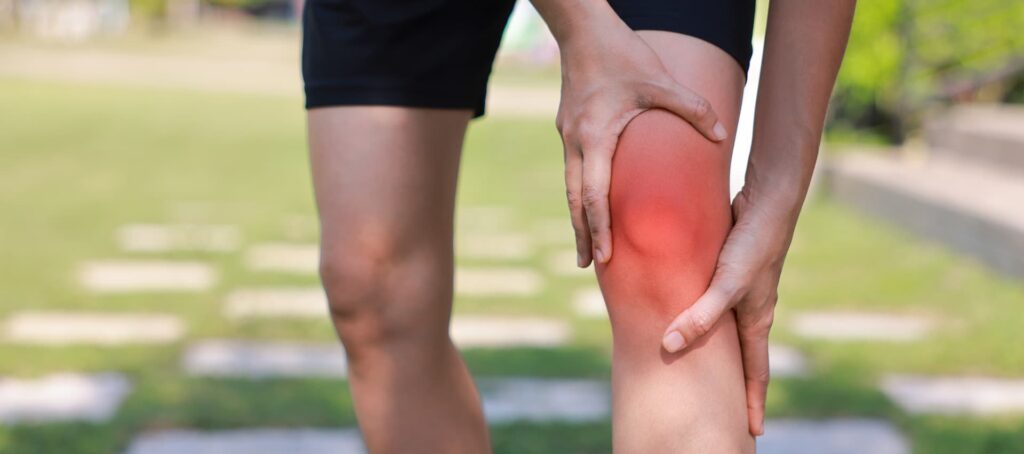
According to the American Academy of Family Physicians (AAFP), the three most common knee injuries are sprains, ACL injuries, and medial meniscal lesions. These injuries happen in sports like skiing, volleyball, football and soccer. To help people with those and other knee injuries, we have developed a 4-step guide to go from injured to playing sports again. First is receiving a diagnosis and plan, second, recognizing when your knee is ready, third, how to ease into exercises, and fourth, how to gently return to your former activities. We also weigh in on a popular knee strengthening protocol called Knees Over Toes.
The Three Most Common Knee Injuries
The AAFP’s table titled “Frequency of Acute Knee Injuries in Young Adults” lists the three most common knee injuries as:
1. Sprain/strains 33.9%,
2. ACL injuries 20.3% and
3. Medial meniscal lesion 10.8%.
M Majewski et al’s Epidemiology of athletic knee injuries: A 10-year study from which the table above draws, lists soccer and skiing as activities leading to most injuries. ACL injuries were associated with handball and volleyball. Medial meniscus is associated with tennis and jogging. Sprain and strains are associated with football (male only), basketball, and soccer from Gray and Buford’s Knee Strain study from 2015.
For those with a knee injury, the next step to getting back in the game (sometimes literally) is getting a diagnosis and training plan.
Step 1: Get a Training Plan and Diagnosis
General Advice Immediately After A Knee Injury
The American Academy of Orthopaedic Surgeons advises the RICE protocol right after a knee injury. “R” stands for resting your injured knee by not putting weight on it. “I” stands for icing the knee (don’t put the ice directly on the skin). They advise applying ice in 20 minute increments. “C” stands for compression, or lightly bandaging the knee. “E” stands for elevation, elevating the knee higher than the heart when resting to reduce swelling.
Knee Injury Plan and Diagnosis
For diagnosing the knee injury, or seeing what is wrong, seek out a doctor to make sure it’s not something serious. You can speak with your primary care physician who might refer you to an orthopedic surgeon for further diagnosis and treatment. The plan for knee rehabilitation comes next. There’s no one-size fits all when it comes to knee injuries, even for the same injury. According to orthopedic surgeon James Carr II, “Every injury is unique, and there are different demands on your body based on the activities you’re involved in. I won’t give the same advice to an equestrian that I would give to a soccer player, even for the same kind of knee injury.” PEAK Sport & Spine’s post operative physical therapy coordinates with your surgeon so therapy is aligned with medical guidelines. Less severe knee injuries also benefit from PEAK’s physical therapy tailored to your specific injury and goals.
With a plan in place, you’ll want to know if your knee is ready to take on more.
Step 2: Know Your Knee Is Ready For More
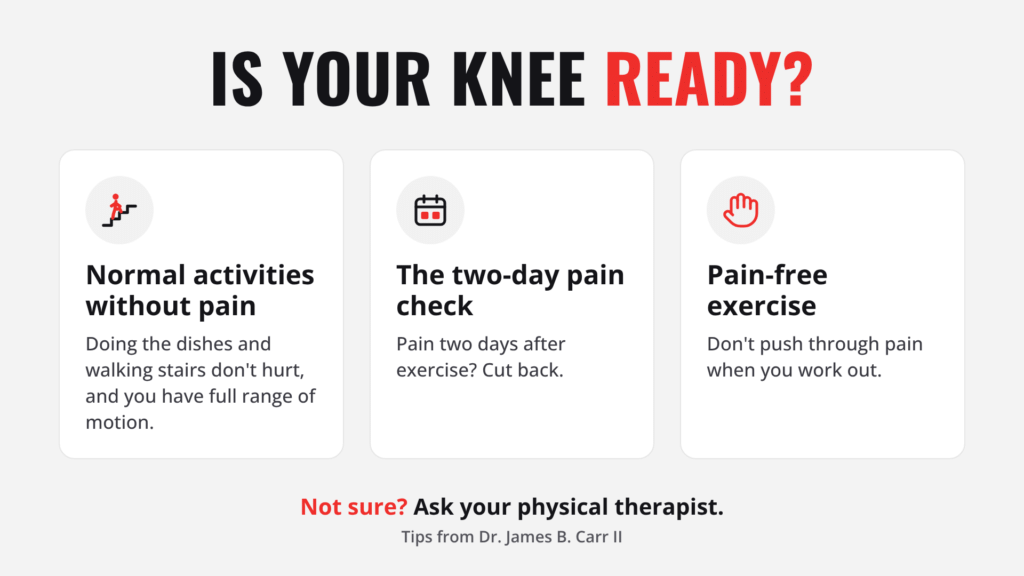
According to Dr. Carr, there are at least three things to check to make sure your knee is ready to take on more.
- Normal Activities Without Pain
If you feel pain while doing the dishes or walking up and down stairs, your knee is not ready to handle more. You should also have full range of motion without pain. - The Two-Day Pain Check
If you exercise and feel pain two days later, you should cut back. - Pain Free Exercise
Do not push through pain when you exercise. Read our article on distinguishing normal soreness from concerning pain to know the difference.
Step 3: Begin With Light Strength Work
To avoid injury, we advise gradually strengthening your knee. The American Academy of Orthopaedic Surgeons says that “Strong muscles help your knee joint absorb shock.” Begin with light strength workouts like bodyweight, band exercises, light weights, or cables. Dr. Carr says to “Avoid Olympic weights and bench presses” and to gradually increase the weight.
Knee Exercises
Before starting any knee exercises, coordinate with your doctor or physical therapist to make sure your exercises will help rather than hurt your knee. Visit the American Academy of Orthopaedic Surgeons Knee Conditioning Program to see all of their exercises. AAOS recommends doing these exercises under doctor supervision. They begin with a low impact activity, stretches, then strength exercises. Some stretches include the heel cord and standing quadriceps stretch to increase range of motion. The strength exercises include half squats, hamstring curls and calf raises. Target muscles include quadriceps, hamstrings, abductors, adductors, gluteus medius and maximus.
When you start to perform squats, you might hear the advice to not let your knees go past your toes.
Can Your Knees Go Over Your Toes?
You may have heard of a popular knee strengthening protocol called Knees Over Toes. We advise consulting your physical therapist or doctor before embarking on any novel knee strengthening protocol.
However, a review on barbell squats in the Journal of Clinical Medicine concluded that restricting anterior knee displacement “…is likely not an effective strategy for healthy trained individuals” with the exception of knee rehab patients. A 2013 review in Sports Medicine on knee joint load and squatting depth concluded that “…deep squats do not contribute increased risk of injury to passive tissues” so long as there is expert supervision, progressive training loads, and technique is learned accurately.
Despite evidence that squat techniques letting knees travel past the toes are safe for some people, those people may not be you (as the review on barbell squats suggests), yet. To see if you are one of those people, consult your doctor or physical therapist.
Step 4: Ease Into Your Sports And More Demanding Exercises
We know you may be eager to do the sports and activities you did before your injury. After following the steps above, you have likely attained more knee strength. If you don’t feel pain, this might even lead you to run headlong and full-force into your cherished activities. This is a mistake according to Dr. Carr. A knee injury, for example, could mean putting more weight on the uninjured knee as well as a general loss of strength, flexibility and coordination. If you were to rush into a sport like soccer, you may unwittingly put more force on the uninjured knee and cause a new injury to it! Dr. Carr advises dedicating twice the amount of time to get back to where you were as the time you were off because of the injury. Once you have built up strength, then gently start your sports. Don’t go full force. A few examples from Dr. Carr of restarting sports gently includes groundstrokes instead of serves in tennis, and beginning with putting and chipping for golf. He also advises checking in with your body to see how you feel afterwards to make adjustments.
How PEAK Sport & Spine Helps You Work Out Again
PEAK helps people with knee injuries across Missouri and Illinois work out again and return to their cherished sports and activities from weekend warriors, to high school athletes or professionals. We coordinate with your surgeon so your post-op therapy is aligned with medical guidelines. If you’ve suffered a knee sprain, ACL tear or medial meniscal lesion, contact us today to schedule an evaluation.