
Imagine it’s been 13 weeks since your spinal fusion. You’ve walked every day as directed but skipped physical therapy. One day, you stop to pick up a box and your back seizes up in pain. Now you are stiff with pain for a week, barely able to move. Your muscles become weaker. The memory of that pain leads you to avoid certain movements entirely, compounding the muscle weakness. While your surgeon might find your spinal fusion progress on track, your clinical recovery that allows you significantly pain-free movement and stable muscle volume lags far behind. Physical therapy helps close that gap. It does this by strengthening your muscles and confidence as the bone heals.
Physical Therapy Matters Even If Your Fusion Is Healing
It can take a significant amount of time for your spinal fusion to heal. MedlinePlus, from the National Library of Medicine, gives a healthy fusion recovery time of at least 3 to 4 months with healing sometimes stretching at least a year. If your condition prior to surgery was severe, your recovery may take longer.
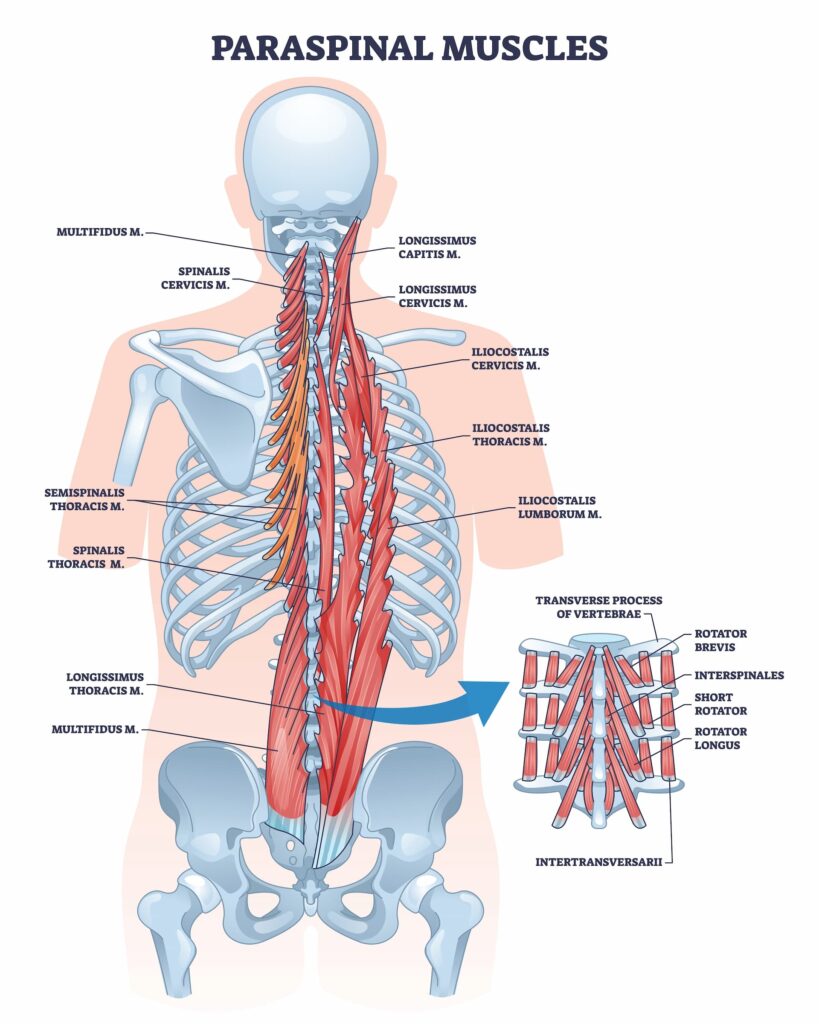
Your fusion is likely not the only part of your body in recovery. Surgeons may need to cut through back muscles depending on the surgical approach. The multifidus, a deep and small vertebra-stabilizing muscle, markedly decreased in volume a year after surgery in a study involving 40 patients with a single-level back fusion. Even if the surgical approach avoids cutting muscle, disuse can lead to muscle loss.
Spine surgeons track bone progression with X-rays, which don’t measure muscle recovery. That’s where physical therapy comes in, working hand-in-hand with your surgeon to rebuild muscle around the fusion. In this way, your exercise routine is tailored to your procedure and your stage of healing.
Skipping Physical Therapy After A Spinal Fusion: What The Research Says
Unsettled questions remain in this area of research, but some available numbers are instructive.
People Receiving Physical Therapy Reported Greater Improvements
A non-randomized study following 123 people after a one- or two-level lumbar fusion found that participants who completed physical therapy “reported significantly positive changes in functional and pain scores than their counterparts” who did not do physical therapy. Since this isn’t a randomized study, there’s the chance the two groups were not similar enough. But this evidence does rise above the level of anecdotal, and agrees with results of rehab after fusion.
Building Confidence In Movement Can Lead To Greater Improvements
People naturally avoid and fear movements that once caused pain to flare up. Research ironically links that fear to disability and longer-lasting pain after lumbar spine surgery. A randomized controlled trial of 86 people, some of whom had a fusion, reached statistical significance when 54.8% who received CBPT (cognitive-behavioral-based physical therapy) reported that their pain decreased a meaningful amount compared to 21.4% of those who received general recovery education without CBPT. Both groups received regular physical therapy. This study suggests that physical therapy tailored to address fear of movement can lead to greater pain relief.
Structured Rehab After Lumbar Fusion Can Reduce Disability and Pain
A 2022 meta-analysis further addresses the fear aspect of the previous study, finding those who did structured rehab, physical therapy coupled with cognitive behavioral training, reported less disability and fear of movement than those who received physical therapy alone after lumbar fusion surgery. The analysis also found those who received physical therapy instead of usual care (basic mobility and information) experienced less pain and disability. Although the study itself considers the evidence low quality, it suggests structured rehab and exercise therapy alone improved outcomes up to six months after the surgery.
When Should Physical Therapy Start After Spinal Fusion?
You might wonder if you’ve passed a cut-off time to begin physical therapy after your surgery.
We recommend you ask your surgeon, who is most familiar with your procedure and its variables, when to start physical therapy. MedlinePlus recommends short walks after your operation for the first two weeks that slowly increase in length. In a few weeks or months, subject to your surgeon’s recommendations, you may begin formal physical therapy.
Research does not agree on any particular time to start PT after a spinal fusion. One randomized study with 82 people saw a near four-fold improvement in a disability score in the group who started PT at the 12th week by the one-year mark compared to those who started on the 6th week after the operation. In that study, it was better to start PT at the 12th week rather than earlier. On the other hand, another randomized trial with 27 patients showed that strength training is safe 3 weeks after a spinal fusion, and leads to earlier functional recovery. As strength training is a treatment within PT, that study seemed to contradict the first by suggesting earlier PT may be better, though the difference disappeared by 18 months.
To sum up, base your PT recovery schedule on your surgeon’s recommendations. Skipping PT when you have the green light can result in less improvement in pain and disability. If you don’t have a PT yet, but are cleared for one, ask your surgeon for a referral. We work with your surgeon to tailor-make a recovery plan after your operation. You can even seek physical therapy directly through Missouri’s direct access, but check if your insurance plan requires prior authorization.
What Physical Therapy After Spinal Fusion Looks Like
Once you are cleared for post op physical therapy, Peak Sport & Spine works with you on your recovery: we communicate with your surgeon, look at your range of motion and goals to make a customized recovery plan. Your recovery moves through four stages: early mobility, strength, functional movement, and returning to activity.
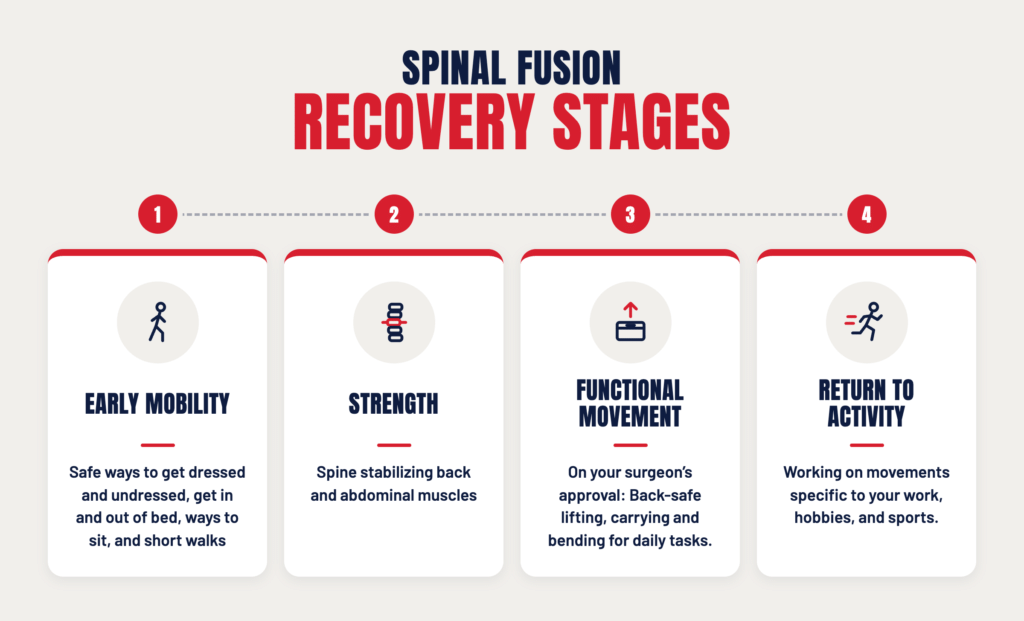
You will receive custom exercises to strengthen your back muscles between PT visits. In our Core Stabilization Program for example, we use exercises to keep your spine neutral to avoid pain while building muscle.
Avoid These Movements and Activities While Your Fusion Heals
Your surgeon tells you what movements to avoid post operation. You may have heard movements to avoid as BLT, which means bending, lifting, and twisting. Here are some movements commonly restricted while your fusion is healing according to MedlinePlus:
- Squat and bend with the knees instead of bending at the waist.
- Don’t lift or carry anything heavier than around 10 pounds (4.5 kilogram), and don’t lift above your head.
- If pain and discomfort are minimal, you may walk up or down the stairs just once a day up to the first 2 weeks after the surgery.
- Don’t start strenuous activities before your surgeon gives you the green light.
- Don’t sit for longer than 20 to 30 minutes if you can help it.
Should you have any of the following, contact your surgeon immediately:
- A fever of 101°F (38.3°C) or higher
- Chills
- Shortness of breath or chest pain
- Wound drainage, or swelling
- Calf pain
- Loss or change of feeling in your feet, legs, or arms
- Trouble urinating or controlling bowel movements
Peak Sport & Spine Spinal Fusion Recovery
We are therapist-owned and experienced in bringing spinal fusion patients from square one back to their daily activities safely, working directly with your surgeon. Peak Sport & Spine exercises are carefully designed to strengthen muscles while your fusion heals. Choose the location nearest you. Request an appointment by completing our form and our staff will contact you within 24 to 48 hours. Call your clinic directly if you are a current patient. Also, be sure to visit our guide on clothes to wear to physical therapy. We’ve got your back!
This article is for educational purposes only and is not medical advice. Talk with your surgeon before starting or changing any exercise or activity after your spinal fusion.